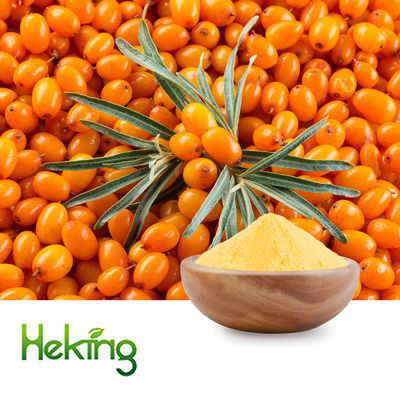
Seabuckthorn is a deciduous shrub with the characteristics of being drought-resistant and wind-resistant. It can survive on saline-alkali land, and is thus widely used for soil and water conservation. Seabuckthorn is extensively planted in the northwest of China for desert greening. The seabuckthorn fruit contains high levels of vitamin C and is known as the "King of Vitamin C". Seabuckthorn is the collective term for the plant and its fruit. The plant seabuckthorn belongs to the genus Crataegus of the family Rosaceae and is a deciduous shrub. It is distributed in North China, Northwest China, and Southwest China. Seabuckthorn is a plant with both medicinal and edible properties. The roots, stems, leaves, flowers, and especially the fruit of seabuckthorn contain rich nutrients and bioactive substances, which can be widely applied in many fields of the national economy such as food, medicine, light industry, aerospace, animal husbandry, fishery, etc. The seabuckthorn fruit has the effects of improving the immunity, stimulating the stomach and digestion, and promoting blood circulation etc. and it is also good to heart health.